Should a 3-Year-Old Know the Alphabets?
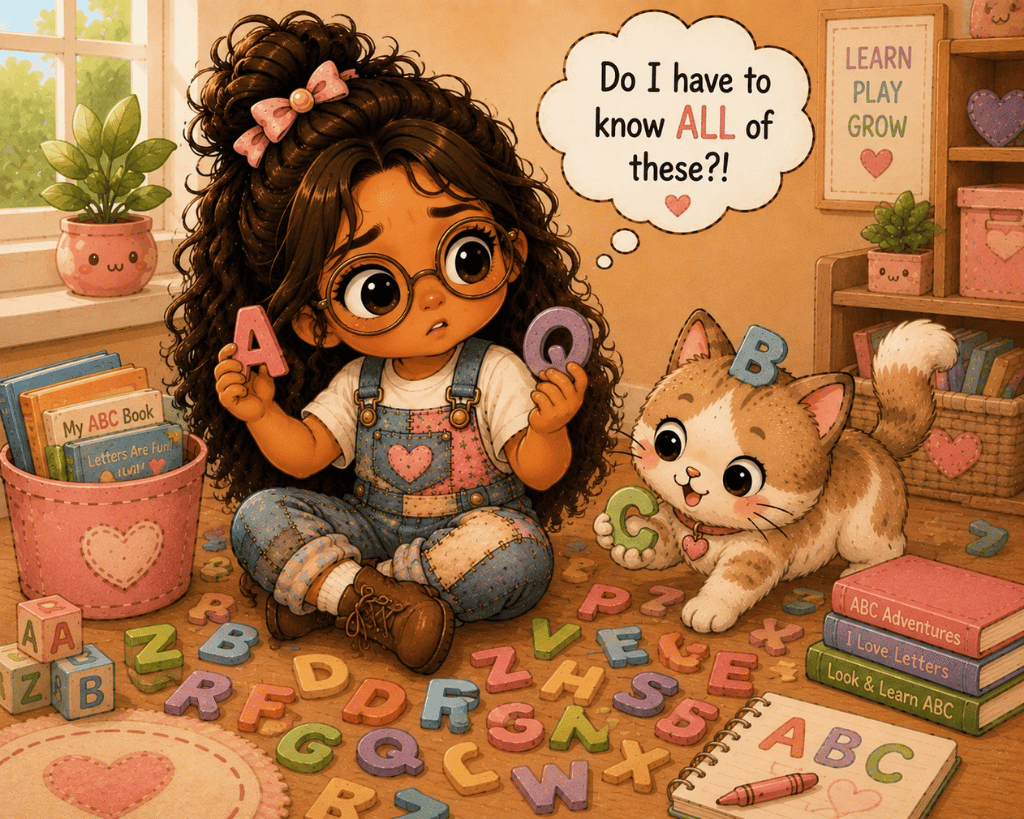
Your 3-year-old is playing happily when another parent casually mentions that their child already knows every letter of the alphabet.
Suddenly, you’re wondering:
Wait… should my 3-year-old know the alphabets too?
Maybe your child can sing the ABC song from beginning to end but can’t recognize most of the letters when you point to them.
Maybe they know the giant M on their bedroom wall because their name starts with M—but have absolutely no idea what a G is.
Maybe they’re not interested in letters at all.
And now you’re wondering whether you should be doing more.
The reassuring answer is that children don’t all learn the alphabet at exactly the same age or in exactly the same way.
At three, learning letters can still be playful, gradual and woven into everyday life.
Let’s look at what “knowing the alphabet” actually means—and how you can encourage early letter learning without turning your home into a classroom.
What Does “Knowing the Alphabet” Actually Mean?
This is an important distinction.
When someone says their 3-year-old “knows the alphabet,” they could mean several completely different things.
A child might be able to:
- Sing the ABC song
- Recognize a few letters
- Name many uppercase letters
- Recognize letters in their own name
- Match uppercase and lowercase letters
- Know some letter sounds
- Recite the alphabet in order
Those aren’t all the same skill.
A child who enthusiastically sings:
A, B, C, D, E, F, G…
has learned a sequence.
That doesn’t necessarily mean they can identify a letter G when they see one.
And that’s okay.
Alphabet knowledge develops gradually.
Should a 3-Year-Old Recognize Every Letter?
You don’t need to treat recognizing all 26 letters as a pass-or-fail test for being three.
Children arrive at alphabet knowledge through different experiences and at different rates.
One 3-year-old might be fascinated by letters and constantly ask what they say.
Another might be much more interested in dinosaurs, mud, building blocks or pretending to run a grocery store.
Their interests matter.
Instead of focusing on whether your child can identify every letter, pay attention to their growing awareness of print, words, books and language.
Learning doesn’t have to happen alphabetically from A to Z either.
In fact, some of the first letters children become excited about are often the ones that mean something to them.
Start With Their Name
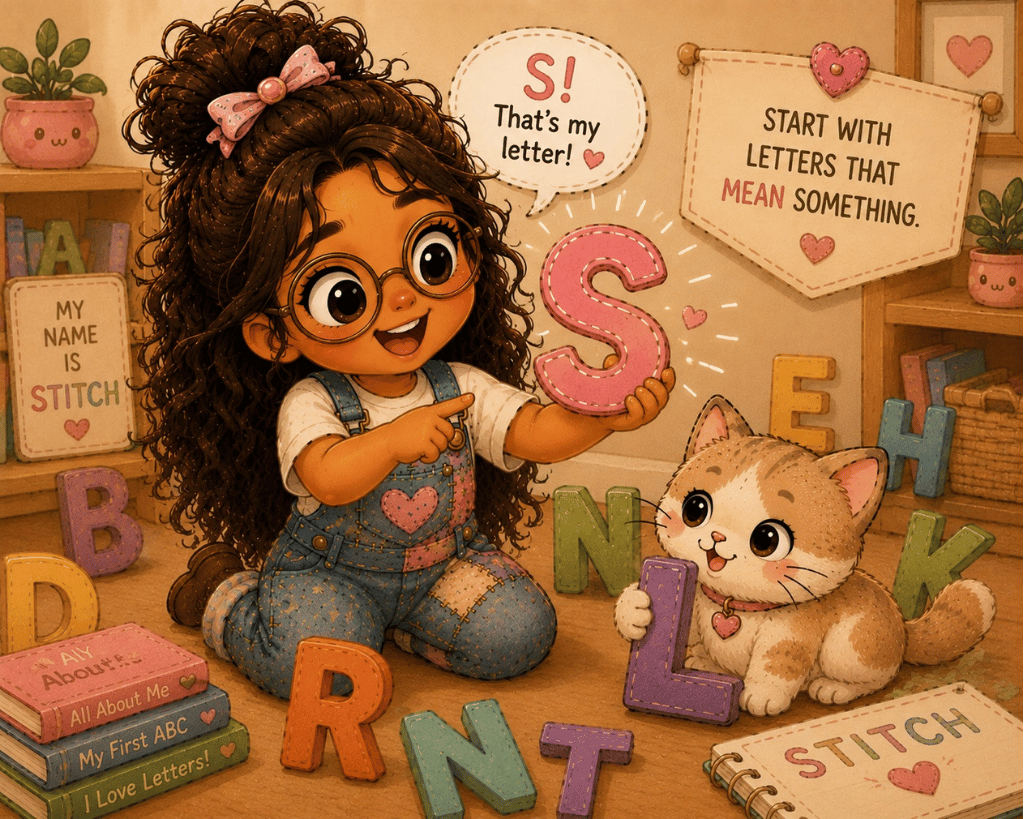
To a 3-year-old, their name is much more interesting than a random collection of letters.
Imagine a child named Mia.
The letter M isn’t just M.
It’s:
“M! That’s MY letter!”
That’s powerful.
You can point out the first letter of your child’s name when you see it.
You might notice it:
On a cereal box.
On a sign.
In a book.
On a fridge magnet.
On their bedroom door.
Eventually you can introduce the other letters in their name too.
Names give letters meaning.
Should My 3-Year-Old Know the ABC Song?
Many young children enjoy learning the alphabet through music, and singing the ABC song is a fun way to become familiar with the sequence of letters.
But being able to sing it isn’t the same as understanding individual letters.
Think about any song you learned as a child in a language you didn’t understand.
You could reproduce the sounds without knowing what every word meant.
Young children can do something similar with the alphabet song.
So sing it.
Have fun with it.
Just don’t use the song as the only measure of what your child understands.
What About Letter Sounds?
You don’t have to wait until every letter name is memorized before talking about sounds.
Letter sounds can appear naturally in conversation.
You might say:
“Ball starts with B. B-b-ball.”
Or:
“Look! That’s S. S like Sam.”
Keep it light.
You don’t need to stop your child every five minutes for an impromptu phonics lesson.
Small moments repeated over time can add up.
Why Does My 3-Year-Old Keep Forgetting Letters?
Because they’re learning.
Adults sometimes forget how much information a letter contains.
Your child has to learn that this shape:
A
has a name.
It can be uppercase or lowercase.
It represents sounds.
It appears inside words.
And somehow they’re supposed to distinguish it from 25 other letters.
For a young child, that’s a lot of new information.
It’s completely possible for your child to correctly identify a letter today and stare blankly at the exact same letter tomorrow.
Repetition is part of learning.
Instead of saying:
“But you knew this yesterday!”
Simply tell them again.
“That’s B.”
Then move on.
Don’t Turn Letter Learning Into Constant Testing
There’s a subtle difference between sharing information and testing a child.
Imagine walking through a shop and repeatedly hearing:
“What letter is that?”
“And that?”
“What sound does that make?”
“What’s this one?”
“You know this.”
“Come on, remember?”
What started as learning can quickly feel like a quiz.
Sometimes simply point things out.
“There’s an enormous A!”
“Hey, that’s the first letter in your name.”
“That sign has two O’s. They look like circles!”
Your child is still being exposed to letters without being required to perform every time.
Make Letters Part of Everyday Life
You don’t need an elaborate curriculum to introduce letters to a 3-year-old.
Letters are already everywhere.
Look for them together on:
- Food packaging
- Street signs
- Clothing
- Books
- Toy boxes
- Restaurant menus
- Shop signs
- Magnets
- Birthday cards
You can turn spotting familiar letters into a game.
“Can you find your letter?”
Suddenly the supermarket becomes a giant alphabet hunt.
Let Them Touch and Build Letters
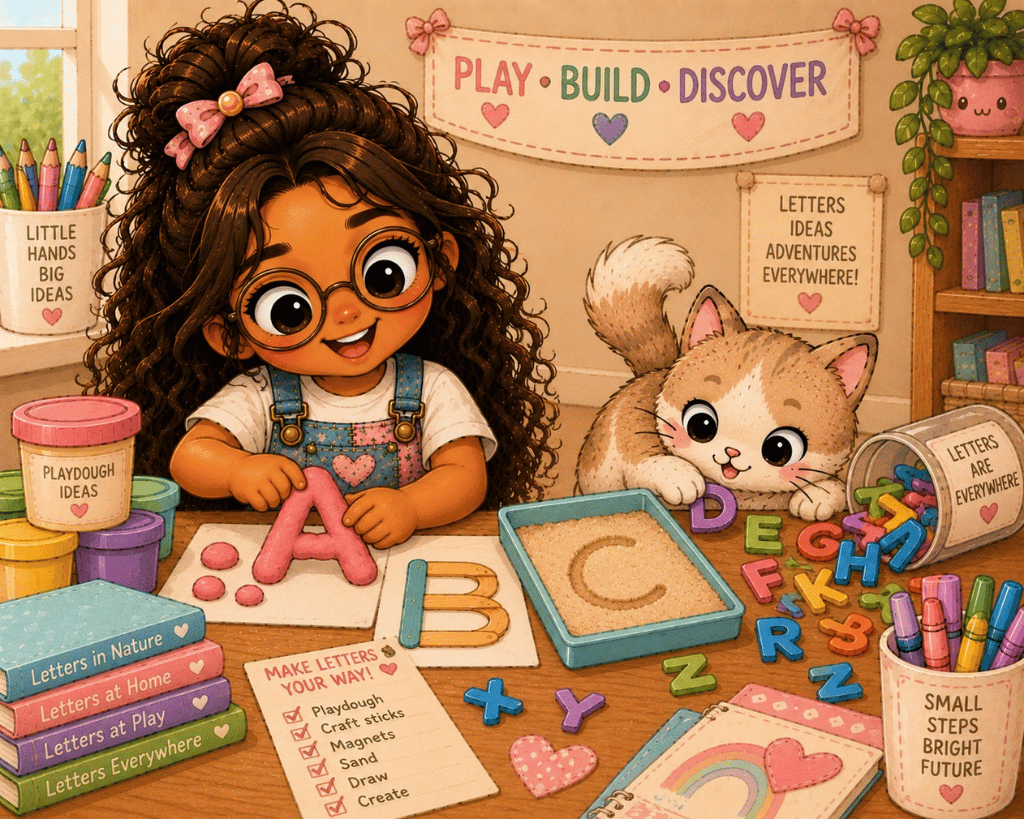
Letters don’t have to live on flashcards.
Young children often enjoy learning through their hands.
Try making letters with:
- Playdough
- Blocks
- Craft sticks
- Magnetic letters
- Chalk
- Finger paint
- Sand
- Toy cars
- Pieces of string
You can draw a giant letter outside with chalk and walk along it.
Make an enormous letter from blocks.
Roll playdough snakes and shape them into letters.
Write letters in sand with a finger.
The activity doesn’t have to look like traditional “school” to involve learning.
Read Together
One of the simplest ways to surround your child with language and print is to read together regularly.
You don’t need to turn every story into a lesson.
Enjoy the book.
Talk about the pictures.
Make silly voices.
Let your child turn the pages.
Read their favorite story for the hundredth time.
Occasionally you can point out something interesting:
“Look at that giant B!”
But you don’t have to analyze every word on every page.
Books can simply be books.
Follow Your Child’s Interests
Suppose your child couldn’t care less about an alphabet poster.
But they absolutely adore trucks.
Now letters can become:
D is for dump truck.
E is for excavator.
F is for fire truck.
A dinosaur-loving child might enjoy matching letters with dinosaur names.
An animal-loving child might become fascinated with:
C for cat.
D for dog.
L for lion.
You’re not tricking them into learning.
You’re connecting something unfamiliar to something they already care about.
What If Other 3-Year-Olds Know More Letters?
This is where parenting can get difficult.
It’s incredibly easy to compare.
Another child recognizes every letter.
Another can write their name.
Another is counting much higher.
Another can already read a few words.
Your child might be doing things those children aren’t doing yet.
Development isn’t a race with everyone moving along the same track at the same speed.
Comparisons can also tempt us to push children harder simply because somebody else’s child has learned something first.
Instead, look at your child’s progress over time.
Are they becoming more curious about books?
Do they notice print?
Are they learning new words?
Do they recognize more letters than they did several months ago?
Those changes matter.
Do I Need Flashcards?
Not necessarily.
Some children genuinely enjoy flashcards.
If yours does, wonderful.
If your child runs in the opposite direction the moment they appear, you have plenty of other options.
Alphabet learning can happen through:
- Songs
- Books
- Games
- Puzzles
- Magnets
- Drawing
- Crafts
- Playdough
- Letter hunts
- Conversation
- Everyday life
There’s no prize for making learning look as much like school as possible.
How Long Should We Practice Letters?
At three, you don’t need to turn alphabet learning into a long formal lesson.
A few enjoyable minutes can be plenty.
Your child might spend two minutes finding magnetic letters and then suddenly decide they’re dinosaurs who need to live under the couch.
That’s preschool life.
Follow the moment.
You can come back to letters another day.
Short, positive experiences repeated over time can be far more inviting than forcing a child to sit through an activity they’ve stopped enjoying.
What If My 3-Year-Old Isn’t Interested in Letters at All?
Keep exposing them to language and print naturally.
Read together.
Sing.
Talk.
Tell stories.
Point out their name.
Keep books accessible.
Play.
Let letters exist around them without making them the center of every activity.
Interests change quickly at this age.
The child who ignores alphabet magnets today may become fascinated with writing their name later.
When Should I Ask Someone About My Child’s Development?
One isolated skill—such as not knowing many letters—doesn’t give you a complete picture of a child’s development.
If you have broader concerns about your child’s speech, language, learning, hearing, communication or development, speak with your child’s pediatrician or another appropriately qualified professional.
They can consider the whole child rather than one alphabet skill.
Your 3-Year-Old Doesn’t Need an Alphabet Deadline
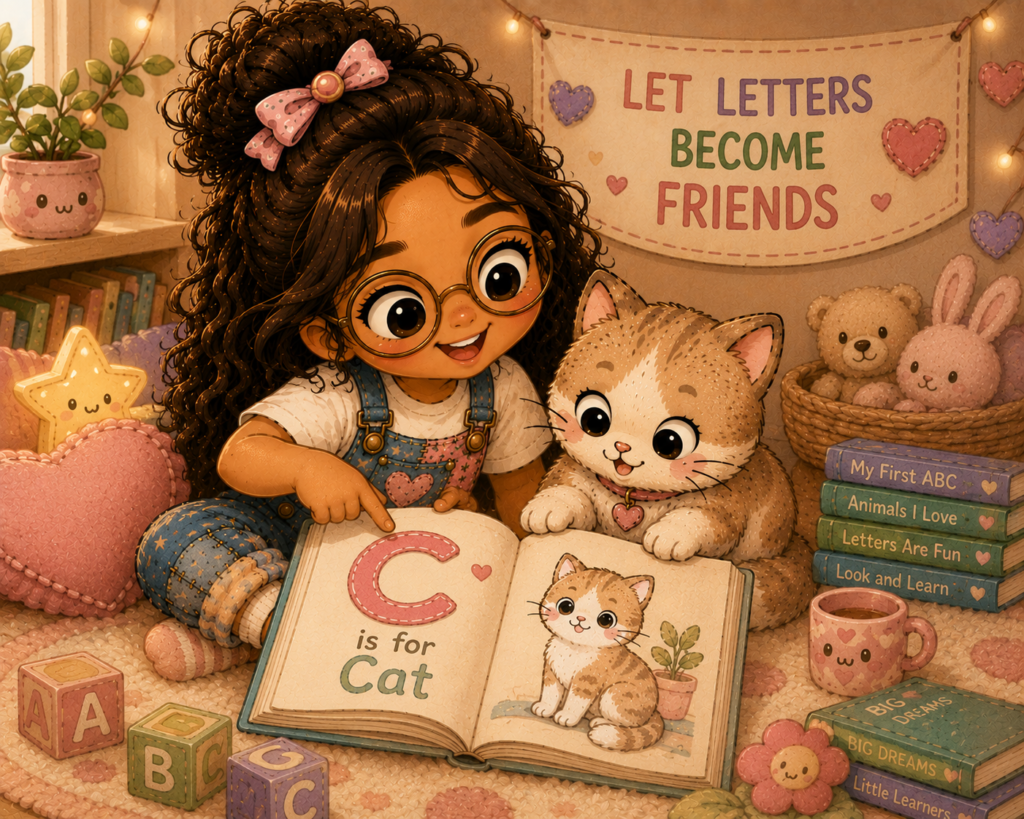
It’s easy to feel as though childhood comes with an invisible checklist.
Know this by three.
Do this by four.
Master that before school.
But learning doesn’t always happen neatly.
Your 3-year-old may know ten letters.
Or three.
They may recognize the first letter of their name every single time and forget almost everything else.
They may enthusiastically sing the ABC song while having very little idea what those individual letters look like.
They’re still learning.
Read together. Sing together. Notice letters. Play with words. Build things. Draw things. Talk about the world around you.
And give those 26 little letters plenty of opportunities to become familiar friends.