Why Can’t My Child Use Scissors?
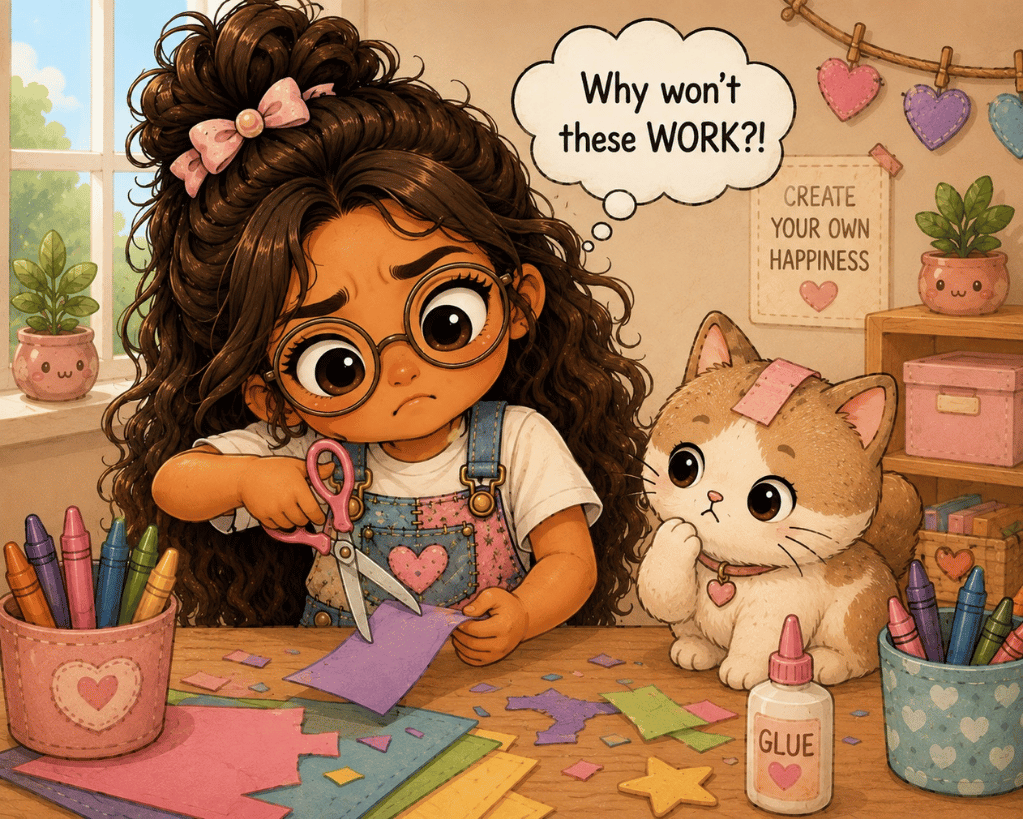
You hand your child a pair of child-safe scissors and a piece of paper.
They put their fingers into the holes.
Turn the scissors sideways.
Swap hands.
Open their mouth while trying to open the blades.
Somehow turn the paper upside down.
And after all that concentration… the scissors still won’t cut where they want them to.
If you’ve watched another child of a similar age happily snipping away, you may start wondering:
Why can’t my child use scissors?
Learning to use scissors is more complicated than it looks. Cutting requires your child’s hands, fingers, eyes and brain to coordinate several movements at the same time.
For young children, that’s a lot.
Some children pick up scissor skills quickly. Others need considerably more time and practice.
Here are some of the reasons your child may be finding scissors difficult—and some simple things you can try.
1. Their Hands May Still Be Developing the Strength They Need
Using scissors requires repeated opening and closing movements.
Try cutting through a thick piece of cardboard yourself and you’ll quickly notice how much work your fingers are doing.
For a young child whose hands are still developing, even ordinary paper can require concentration.
You don’t necessarily need to start with more cutting practice.
Activities that get little fingers working can help too.
Try:
- Squeezing and rolling playdough
- Using tongs to pick up small objects
- Playing with building blocks
- Squeezing sponges during water play
- Peeling and placing stickers
- Threading large beads
- Tearing paper
- Using clothespins
- Playing with connecting toys
These activities allow children to use their hands in different ways without making scissors the focus.
2. Opening and Closing Scissors Is a New Movement
Adults barely think about it:
Open.
Close.
Open.
Close.
For a child, coordinating that movement can be surprisingly difficult.
You may see them use both hands to pull the scissors open or repeatedly close the blades without knowing how to open them again.
Before worrying about following lines, let your child practice the basic movement.
They can simply make little snips along the edge of a piece of paper.
No lines.
No shapes.
No destination.
Just:
Open. Snip. Open. Snip.
Learning the movement itself is an achievement.
3. Holding the Scissors Is Only Half the Job
There’s something we adults tend to forget when watching a child cut.
One hand operates the scissors.
But what’s the other hand doing?
It has an important job too.
Your child’s other hand needs to hold the paper, move it and sometimes rotate it while the cutting hand continues opening and closing the scissors.
Both sides of the body are working together.
That’s one reason cutting around a circle is much harder than making a straight snip through a strip of paper.
If your child can make little snips but struggles to follow a shape, they may simply be working on coordinating both hands.
4. They May Be Holding the Scissors Upside Down
This happens all the time.
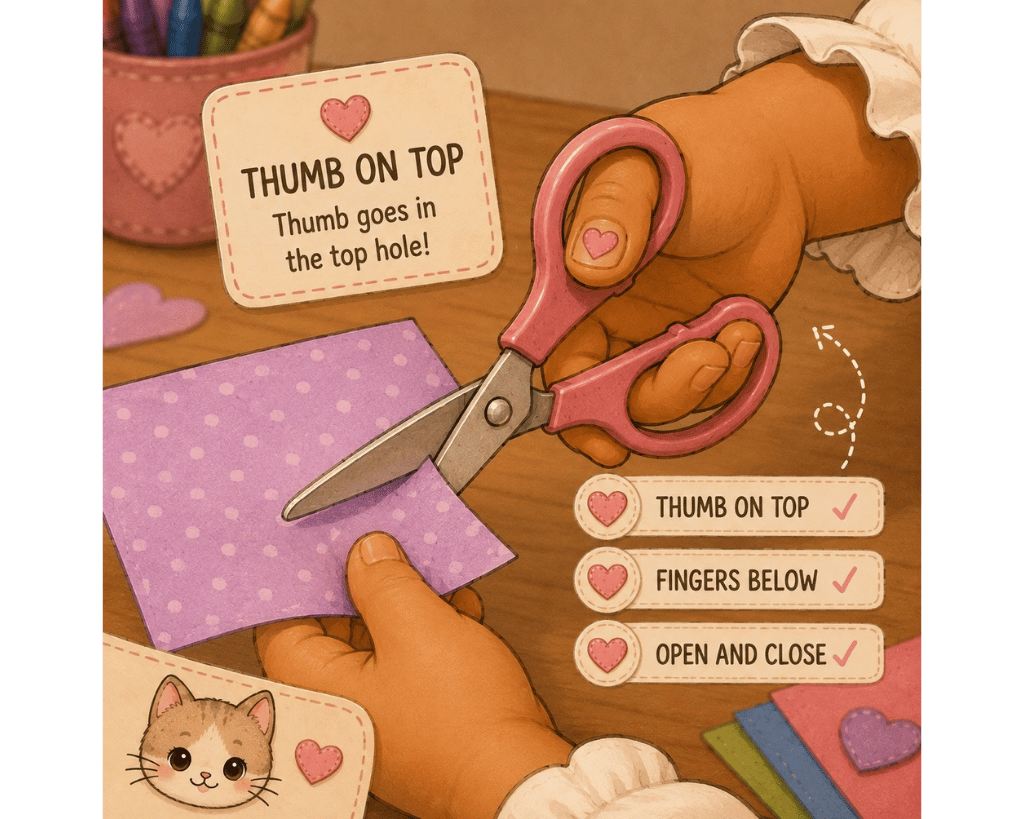
A simple reminder you may find useful is:
Thumb on top.
You can even place a tiny sticker on your child’s thumbnail and say:
“Keep the sticker looking at the ceiling.”
It gives them something visual to remember instead of repeatedly correcting their grip.
Try to keep instructions short.
When a child is already concentrating on their fingers, the paper, the blades and where they’re trying to cut, a long explanation can make the activity even harder.
5. The Scissors Might Be the Problem
Sometimes it isn’t your child’s skill.
It’s the scissors.
Scissors that are too large, uncomfortable, stiff or difficult to open can make learning unnecessarily frustrating.
Choose scissors designed specifically for young children and make sure they’re appropriate for your child’s age and ability.
Your child may also find one style easier to use than another.
If they’re struggling, don’t automatically assume they need more practice with the same pair.
The tool itself may be making the task harder.
6. You’re Starting With Something Too Difficult
Imagine learning to write and being immediately asked to copy an entire paragraph.
That’s a little like handing a beginner a picture of a dinosaur and asking them to cut perfectly around it.
Cutting skills usually become more complex gradually.
A child might progress from:
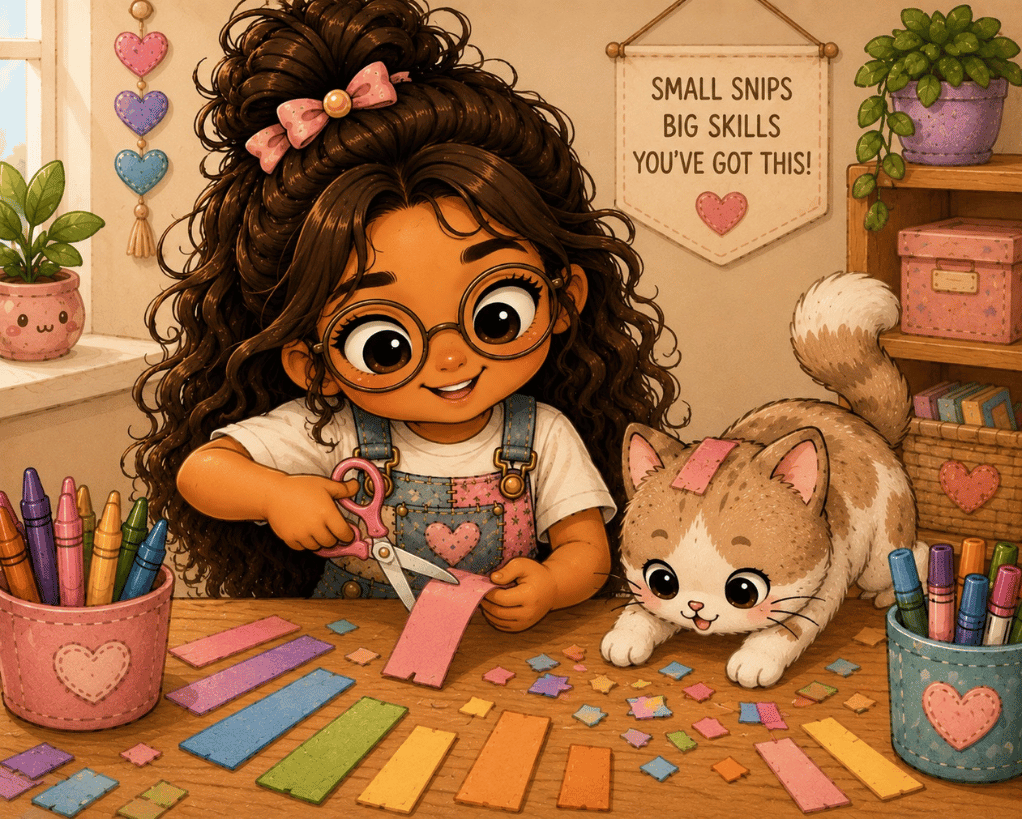
Snipping paper
to
Cutting across a strip
to
Following a straight line
to
Following curved or zigzag lines
and eventually to
Cutting around shapes and pictures.
If your child can’t cut around a circle yet, go backwards.
Give them something easier.
Success builds confidence.
7. The Paper May Be Too Floppy
Regular printer paper seems like the obvious material for cutting practice, but it can be surprisingly difficult for beginners.
Thin paper bends, folds and moves while your child is trying to control the scissors.
Try something slightly sturdier.
Depending on your child’s age and the scissors being used, you might experiment with:
- Cardstock
- Construction paper
- Paper strips
- Old greeting cards
- Thin craft card
You can also cut paper into smaller strips before giving it to your child.
Holding a narrow strip can be much easier than controlling an entire sheet.
8. They May Be Frustrated Because They Can’t Make the Scissors Go Where They Want
Your child knows where they want to cut.
Their hand just isn’t cooperating yet.
That’s frustrating.
You might hear:
“I can’t!”
“You do it.”
“It’s not working!”
Or the scissors simply get abandoned.
At this point, more pressure usually isn’t particularly helpful.
Make the task easier.
Try a shorter line.
Use a thicker line.
Let them make random snips.
Try again another day.
Learning to use scissors doesn’t have to happen in one afternoon.
What Age Should a Child Be Able to Use Scissors?
There isn’t one birthday when children suddenly become competent with scissors.
Scissor skills develop gradually, and children won’t all progress at exactly the same pace.
Young children may begin by exploring age-appropriate scissors and making simple snips before progressing toward increasingly controlled cutting.
Instead of asking whether your child can “use scissors,” look at the individual skills they’re developing.
Can they open and close the scissors?
Can they make a snip?
Can they cut across a short strip?
Can they move the scissors forward?
Can they begin following a line?
Can they turn the paper while cutting?
These are separate achievements.
How Can I Teach My Child to Use Scissors?
Keep the first activities incredibly simple.
Start with snipping
Cut paper into narrow strips.
Let your child snip pieces off the end.
That’s it.
They don’t need to follow a line yet.
Move to short straight lines
Once snipping becomes easier, draw thick, short lines from the edge of the paper toward the middle.
Your child only needs a few cuts to reach the end.
Make the lines longer
Gradually increase the distance.
Introduce different paths
When straight lines become comfortable, experiment with gentle curves, waves and simple zigzags.
Save complicated shapes for later
Circles, detailed pictures and shapes with lots of corners require much more coordination.
There’s no hurry.
Make Cutting Practice Feel Like Play
A piece of paper covered in practice lines can feel like work.
But those exact same cutting movements can become part of play.
Draw grass along the edge of green paper and let your child give it a “haircut.”
Make a lion with long strips around its face and trim its mane.
Cut pretend spaghetti.
Snip strips to make confetti.
Cut out simple pieces for a collage.
Give a paper monster a funny hairstyle and let your child trim it.
Suddenly they’re not practicing scissors.
They’re making something.
And that’s often much more interesting.
What If My Child Uses Their Left Hand?
Don’t automatically move the scissors into their right hand.
If your child naturally prefers using their left hand, make sure the scissors they’re using are suitable for left-handed cutting.
Also think about how you’re demonstrating the activity.
Sitting opposite your child can make movements look reversed. Sitting beside them may make it easier for them to see what your hands are doing.
Don’t Worry About Perfect Lines
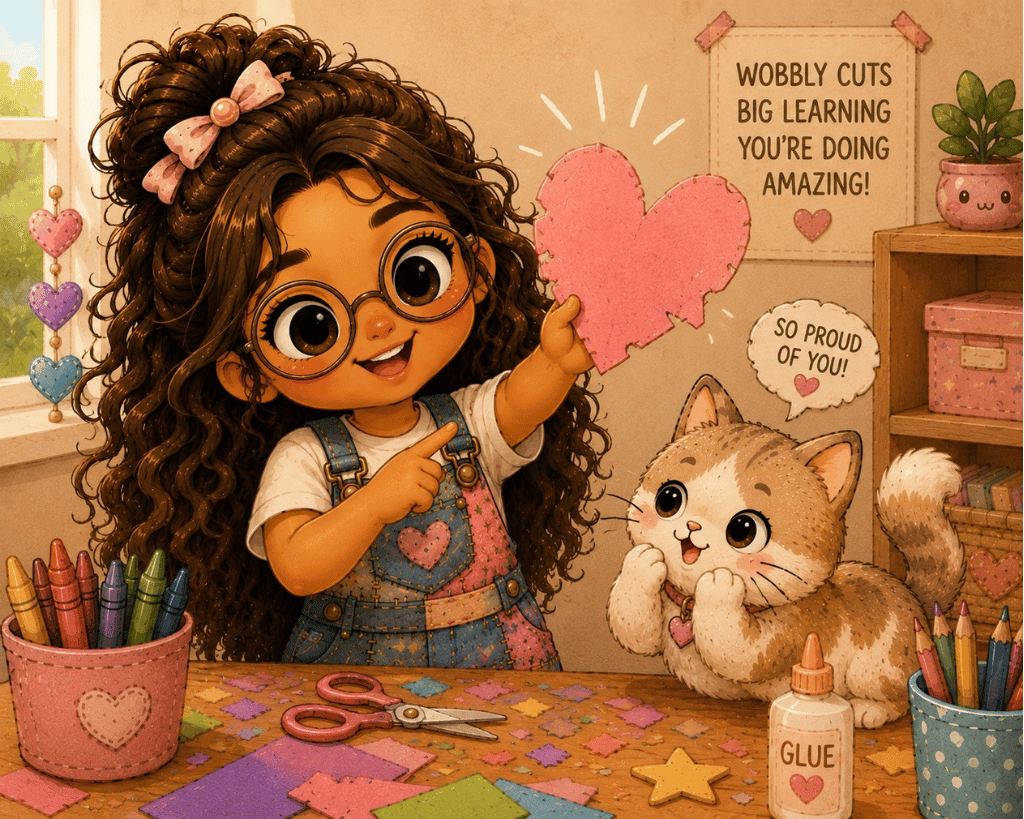
When children are learning to cut, the goal isn’t a perfectly smooth circle.
Look at what your child had to do to get around that wobbly shape.
They had to:
- Hold the scissors
- Open and close them
- Move forward
- Watch the cutting line
- Hold the paper
- Rotate the paper
- Coordinate both hands
- Decide where to move next
That’s a lot happening at once.
A very wobbly cut can represent a lot of learning.
When Should I Be Concerned?
Difficulty using scissors by itself doesn’t tell you that something is wrong.
Children develop skills at different rates, and some have far more experience with cutting and craft activities than others.
However, if you’re concerned about your child’s overall hand skills, coordination or development—or you’re noticing persistent difficulties across several everyday activities—talk to your child’s pediatrician, teacher, occupational therapist or another qualified professional.
They can consider your child’s development as a whole rather than judging them by one activity.
Scissor Skills Take Practice
When adults use scissors, the movement is so automatic that it’s easy to forget how complicated it once was.
Your child is learning where to put their fingers, how to move the blades, how to control the paper, where to look and how to coordinate two hands—all at the same time.
Start small.
Let them snip.
Let the lines be wobbly.
Turn practice into play whenever you can.
And celebrate the tiny milestones.
Because that first little snip across a piece of paper?
For those little hands, it’s actually a pretty big accomplishment.